

Call us: +86-137-2353-4866

You need to pick the right force sensing resistors for your project in 2025. Top brands like SOUSHINE, Interlink, Tekscan, FlexiForce, SparkFun, and Ezweiji use advanced force sensing technology. They offer smaller sizes, better sensitivity, and options you can change. The market for force-sensitive resistors is growing quickly. This is because they are needed in cars, healthcare, robots, electronics, factories, and airplanes.
- The global force sensitive resistor market was worth USD 675 million in 2024.
- Experts think it will grow by 8.1% each year, reaching USD 1,311 million by 2033.
You should look at how well they work, if you can buy them easily, and if they fit your project when you compare force sensing resistor choices.
Table of Contents
Key Takeaways
- Force-sensitive resistors (FSRs) measure force by changing resistance. They do this when you press them. This makes FSRs useful in many devices.
- The market for FSRs is growing very fast. It may reach USD 1,311 million by 2033. Many industries want FSRs, so demand is high.
- When you pick an FSR, look at sensitivity and range. These things show how well the sensor finds small and big forces.
- Durability is important. Some FSRs can last over 1,500,000 uses. This makes them great for jobs that need lots of use.
- Price changes by brand and features. You should balance cost and performance. This helps you get good value for your project.
- FSRs are used in cars, healthcare, robots, electronics, and factories.
- Some brands like SOUSHINE let you customize FSRs. You can change sensors to fit your project needs.
- Always test your FSRs before you use them. This makes sure they work right for accuracy and sensitivity.
Force-Sensitive Resistors Explained
How Force-Sensitive Resistors Work
Resistance Change Principle
Force sensing resistors help you measure force on a surface. When you press the sensor, resistance goes down. This change helps you see force right away. There are three main ways these sensors work:
- Percolation: When you press, paths form inside the sensor. More force makes more paths, so resistance drops.
- Quantum Tunneling: Electrons move through tiny gaps in the material. This movement changes resistance as you press.
- Contact Resistance: The sensor’s electrodes touch a special polymer. Pressing makes the contact area bigger, so resistance gets lower.
These ways help force sensing resistors react fast and sense small changes. You can trust them for many uses.
Construction and Materials
Force sensing resistors use flexible bases, spacers, and layers that conduct electricity. Makers use polymers with tiny conductive bits inside. This makes the sensor thin and light. You can bend or shape it for your needs. The materials help the sensor last longer and work in hard places. You find these sensors in devices that need little power and work well.
Applications in 2025
Force sensing technology is growing fast. You see force sensing resistors in many fields. The table below shows how force sensors and pressure sensors are different:
| Criteria | Force Sensor | Pressure Sensor |
|---|---|---|
| Measuring range | Measures total force (Newtons, lbs) | Measures pressure (Pascals, psi) |
| Sensitivity | Detects small force changes | Detects small pressure changes |
| Accuracy | Matches measured force to true force | Matches measured pressure to true value |
| Response time | Responds quickly to force changes | Responds quickly to pressure changes |
| Measuring depth | Measures force at contact points | Measures pressure in fluids/gases |
You find force sensing resistors in these areas:
Automotive
Force sensing resistors are in motor control, steering, and brakes. They also help with driver assistance systems. These sensors make cars safer and work better. The car industry uses the most force sensing resistors.
Healthcare
Force sensing resistors help watch patients and do tests. They track movement and pressure in rehab tools. Healthcare uses more sensors as tech gets better.
Robotics
Robots use force sensing resistors for touch and grip. These sensors help robots move with care and be more exact. You see them in factories for careful work.
Consumer Electronics
Force sensing resistors are in touch screens and wearables. These sensors make gadgets react faster. More wearables mean more need for good sensors.
Industrial Automation
Factories use force sensing resistors for robots, packing, and checking products. These sensors help jobs get done faster and better. More companies use robots, so this field grows fast.
Aerospace
Force sensing resistors are in planes and defense tools. They help test and watch how things work. Engineers use them for strong and steady results.
Tip: Pick a force sensitive resistor with the right sensitivity and accuracy for your project. This helps your project work its best.
Comparing Force Sensing Resistors
Sensitivity and Range
When picking force sensing resistors, look at sensitivity and range first. Sensitivity means the sensor can notice small pressure changes. Range tells you the smallest and biggest force it can measure. If you need to measure soft touches or strong pushes, check these numbers. Most sensors can sense from a light tap to a hard press. Many models can measure forces from 0 to 20 pounds (0 to 100 Newtons) in a small spot. The resistance goes from almost endless with no pressure to about 200 ohms when pressed hard. Some sensors, like FlexiForce A201, have different ranges for light, medium, or heavy loads. This lets you pick the best sensor for your project.
| Specification | Value |
|---|---|
| Resistance Range | Infinite (no pressure), 100KΩ (light), 200Ω (max pressure) |
| Force Range | 0 to 20 lb. (0 to 100 Newtons) |
Tip: Make sure the sensitivity and range fit your project. This helps you get good results and correct measurements.
Accuracy and Repeatability
Accuracy and repeatability are important for getting good data. Accuracy means the sensor shows the real force. Repeatability means you get the same reading each time with the same force. Different sensors can change with heat, bending, or surface changes. You might need to set up each sensor for your project. Setting up helps lower mistakes and gives better results. In medical and robot projects, you want sensors that stay correct even if things change. A special setup method can help keep accuracy high when things around the sensor change.
Durability and Lifespan
You want sensors that last long, especially for hard jobs. Durability means how many times you can use the sensor before it breaks. Lifespan is how long the sensor works well. Some sensors last up to 1,500,000 uses, while others last 500,000 uses. The table below shows how some models compare:
| Sensor Model | Durability (Cycles) | Rating (out of 5) |
|---|---|---|
| Model A | 1,000,000 | 4.5 |
| Model B | 800,000 | 4.0 |
| Model C | 1,500,000 | 4.7 |
| Model D | 500,000 | 3.8 |
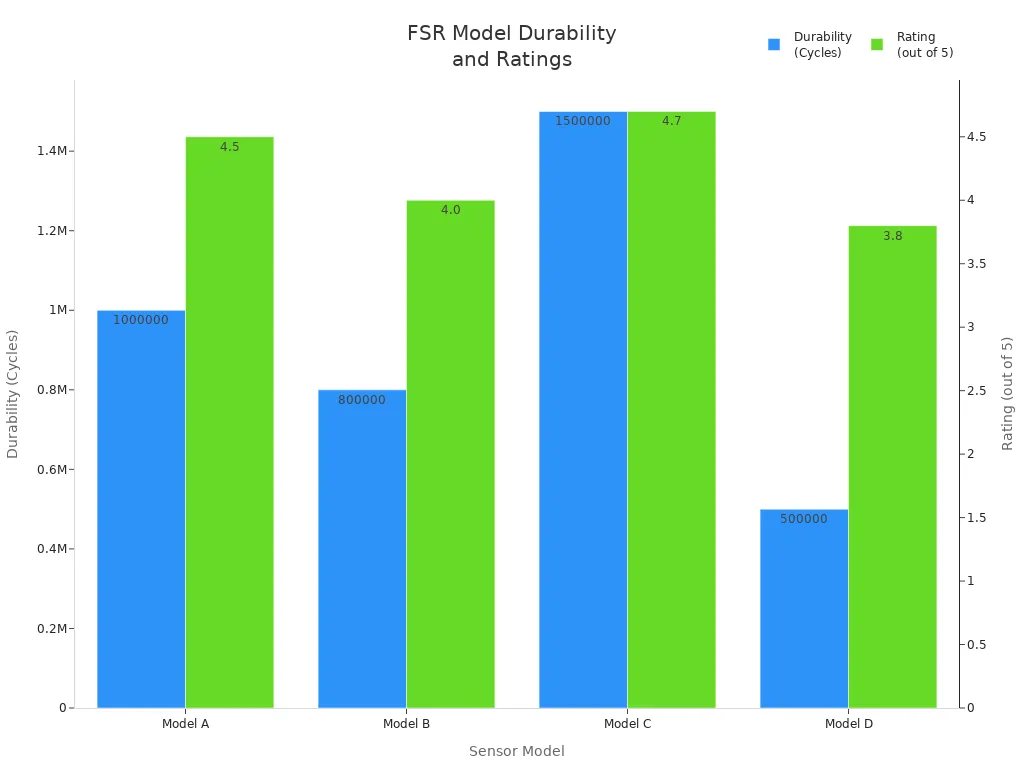
Pick force sensing resistors with high durability for jobs with lots of use. This helps you avoid changing them often and keeps your system working well.
Price and Value
You want to get good value when buying force sensing resistors. Prices are different for each brand and design. Some sensors are cheaper but might not last long. Others cost more because they work better and last longer. You should think about both price and how well the sensor works.
Here is a table that shows prices for popular brands in 2025:
| Brand | Price Range (USD per unit) | Main Focus |
|---|---|---|
| SOUSHINE | $2 – $10 | Customization, durability |
| Interlink | $3 – $12 | Sensitivity, reliability |
| FlexiForce | $5 – $18 | Thin design, flexibility |
| Tekscan | $8 – $25 | High accuracy, research |
| Ezweiji | $1 – $5 | Low cost, basic use |
SOUSHINE and Interlink have good prices and features. Tekscan and FlexiForce cost more because they are more accurate and flexible. Ezweiji is cheap and good for simple jobs.
- Brands use special materials and designs. This can make prices go up.
- Sensors that last longer or have custom shapes cost more money.
- If you buy sensors that work better and last longer, you save money later.
Tip: Do not pick the cheapest sensor only. Think about how long it will last and if it works well for your project.
Application Suitability
You need to choose force sensing resistors that fit your job. Each sensor works best for certain tasks. Check sensitivity, accuracy, and durability for what you need.
- In healthcare, sensors help track movement and pressure. They can be used in hospital beds to stop bed sores. They also help watch when pills are taken from bottles.
- Medical devices use force sensing resistors inside the body. Cardiac catheters and endoscopes use them to give doctors important data.
- In robotics, sensors help robot arms feel touch. This lets robots move carefully and do exact jobs. Robots in factories use force sensing resistors to put parts together with the right pressure.
- Consumer electronics use sensors for touch screens and wearables. You get fast response and a better experience.
- Industrial automation uses sensors to check products and control machines. This helps make better products and faster work.
- Aerospace needs sensors that work in hard places. Engineers use them to test and watch equipment.
Always pick a force sensitive resistor that matches your job. Look at sensitivity, accuracy, and durability. This helps you get good results and trust your measurements.
Note: Custom shapes and sizes help you fit sensors into special designs. Ask brands like SOUSHINE about custom sensors if you need them.
Top Force Sensitive Resistor Brands
SOUSHINE Force Sensing Resistors
Features
SOUSHINE makes advanced force sensing resistors. These sensors are very sensitive and accurate. You can use them in many different projects. They last a long time, even if used a lot. They use little power, so they are good for portable devices. You can add these sensors to new or old products easily. SOUSHINE sensors give steady and reliable measurements.
- Detects small force changes well
- Works for a long time, even with lots of use
- Uses little power, good for battery devices
- Easy to add to many systems
Customization
SOUSHINE lets you change their force sensing resistors to fit your needs. You can pick the size, shape, and thickness you want. You can also choose the output signal and how it is set up. This helps you get the right results for your project. You can ask for almost any shape or size. This gives you lots of design choices.
- Pick your own size, shape, and thickness
- Change output signal and setup
- Special solutions for different projects
Note: Changing the sensor helps you get the best value for your project.
Applications
SOUSHINE force sensing resistors work in many areas. In cars, they help make driving safer and better. In healthcare, they help watch patients and help with rehab. Robots use these sensors for touch and grip. Gadgets use them for quick and exact touch. Factories and planes also use SOUSHINE sensors because they last long and measure well.
Interlink Electronics
Features
Interlink Electronics has many force sensing resistors and touchpads. You can pick from lots of models, like the VersaPad line. The newest VersaPad Plus has a big surface and can sense more than one touch. Special spots let you scroll and right-click easily. These sensors are sensitive and work well for many jobs.
- Many models to choose from
- Can sense more than one touch
- Special spots for better control
Extra-Long Models
Interlink Electronics has extra-long models for special jobs. These sensors are good for measuring force over bigger areas. They stay sensitive and work well all along their length. You can use them in factories, medical tools, or gadgets that need longer sensors.
Tekscan FlexiForce
Features
Tekscan FlexiForce sensors are very accurate and measure force well. You can measure many different forces with them. Their output stays steady, no matter where you press. Some versions work in high heat, up to 400°F. These sensors are easy to set up because they are very straight in their readings. You can trust them for exact measurements in tough places.
- Very straight and accurate readings (±3%)
- Measures many force levels
- Output stays steady everywhere
- Can work in high heat
Custom Shapes
You can ask Tekscan FlexiForce for special shapes. Their team helps you design sensors for your project. Each custom sensor is tested to make sure it works for you. You get sensors that work well and measure right, even for special jobs.
- Special designs with expert help
- Each sensor is tested for your needs
SparkFun FSRs
Features
SparkFun force sensing resistors are used in lots of projects. They work well and are easy to add to your design. You can pick from many shapes and sizes. This helps you find the right one for your project. These sensors notice both soft and hard touches. They react fast, so you see changes right away. People use them in robots, game controllers, and displays. They are good for simple force checks and give steady results.
The table below lists the main models and their details:
| Name | Shape | Sensing Area | Min Pressure | Max Pressure |
|---|---|---|---|---|
| Force Sensitive Resistor – Small | Circular | 7.62 mm dia | 0.1 kg | 1 kg |
| Force Sensitive Resistor 0.5″ | Circular | 12.7 mm dia | 100 g | 10 kg |
| Force Sensitive Resistor – Square | Square | 44.45 x 44.45 mm | 100 g | 10 kg |
| Force Sensitive Resistor – Long | Rectangular | 6.35 x 609.6 mm | 100 g | 10 kg |
SparkFun sensors can measure many different forces. You can use a small sensor in tight spots. You can use a long sensor for bigger areas. They keep good sensitivity and accuracy. This means you get data you can trust.
Value Options
SparkFun force sensing resistors are a good deal for the price. They work well and do not cost too much. The price changes by model, so you can find one that fits your budget. You get good performance for what you pay. These sensors are sensitive and last a long time.
The chart below shows the highest pressure each SparkFun model can handle:
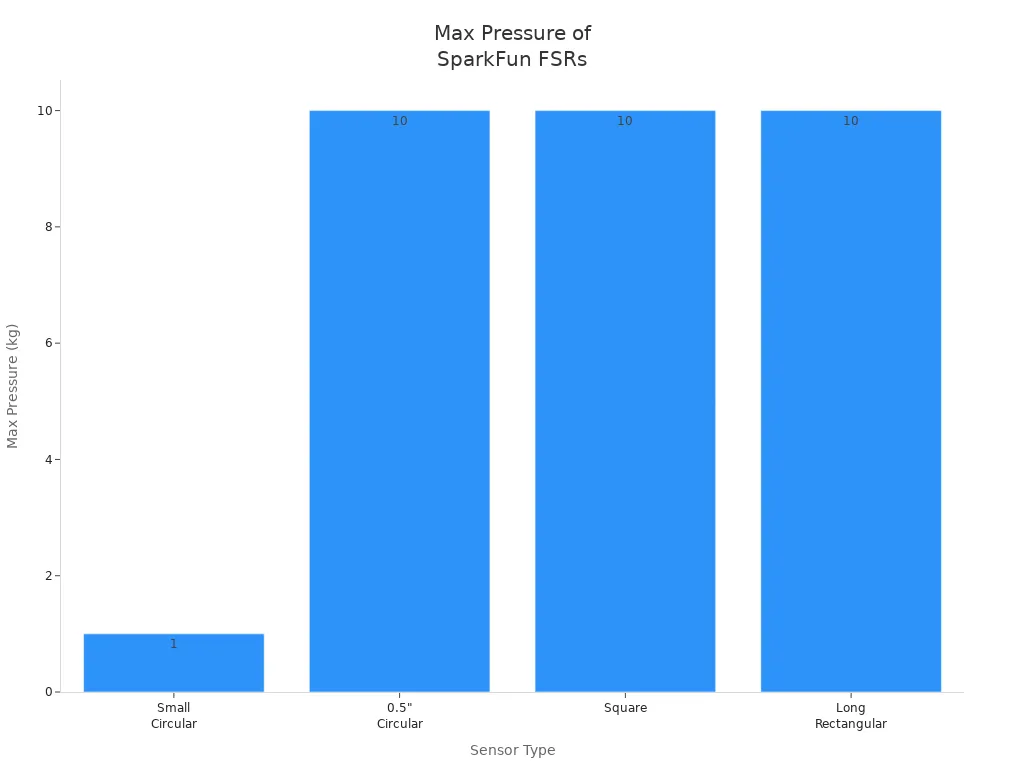
You can use SparkFun sensors for many jobs. They work for simple touch or more advanced force checks. You get flexible design choices and steady results. These sensors help you save money and still meet your needs.
Tip: Always check the price and sensitivity before you buy. This helps you pick the right sensor for your project.
Ezweiji FSRs
Features
Ezweiji force sensing resistors react fast and give steady signals. They are thin and bend easily, so they fit many surfaces. Ezweiji sensors can measure both light and strong forces. You need to adjust them for best accuracy, but they give steady results over time. They are good for real-time feedback and work well in many uses.
Here is a table with the main features:
| Feature | Description |
|---|---|
| Fast Response | Provides quick feedback for real-time applications |
| Steady Output | Maintains consistent signals over time |
| Thin and Flexible | Adapts to various surfaces |
| Wide Force Measurement Range | Capable of measuring both light and strong forces |
| Requires Calibration | Needs adjustment for precise readings |
Ezweiji sensors are sensitive and last a long time. You can use them in projects that need quick and correct force checks.
Extended Sensing
Ezweiji force sensing resistors are used in many fields. They work in medical devices to watch pressure on beds. In robots, they help hands feel grip. Electronics designers use them for touch buttons and sliders. In factories, they help check force and pressure in machines.
- Medical devices for checking bed pressure.
- Robotics for grip sensing in robot hands.
- Electronics for touch buttons and sliders.
- Factories for checking force and pressure in machines.
These sensors can do many jobs and give steady data. Ezweiji force sensing resistors help you get better results in your projects. They are a good value, especially if you need thin and flexible sensors.
Note: You should adjust Ezweiji sensors for best accuracy. This helps you get the most correct force readings.
Force-Sensitive Resistor Model Comparison
Sensitivity and Force Range
When you compare force sensing resistors, check sensitivity and force range. Sensitivity means how well a sensor notices small force changes. If a sensor is very sensitive, it can feel light touches. Force range shows the smallest and biggest force a sensor can measure. You need a sensor that fits your project. Some sensors work better for gentle taps. Others are made for strong presses.
Manufacturers make sensors with different sensitivity levels. Some are good for soft touches. Others are better for heavy loads. Sensors react differently to each type of touch. The table below shows how three force sensing resistor types respond to touches:
| FSR Type | No Touch | 1-Finger Touch | 2-Finger Touch | Palmar Side Touch | Dorsal Side Touch | Max. Change in Register Value |
|---|---|---|---|---|---|---|
| Off-the-Shelf FSR | 26–27 | 1–2 | 0–1 | 0–2 | 1–2 | 25–27 |
| Woven Fabric FSR | 19–21 | 0–2 | 0–1 | 0–1 | 0–1 | 18–21 |
| Embroidered FSR | 57–58 | 0–1 | 0–1 | 0–1 | 0–1 | 56–58 |
Off-the-shelf force sensing resistors show a big range of values. Woven fabric and embroidered models have their own sensitivity styles. Pick a sensor with the right sensitivity and force range for your job. If you need to measure light touches, choose a sensor with a low minimum force. For strong pressure, pick a sensor with a high maximum force.
Tip: Always match the sensitivity and force range to your project. This helps you get good measurements and better results.
Accuracy and Consistency
Accuracy means the sensor’s reading is close to the real force. Consistency means the sensor gives the same result every time you use the same force. You want sensors that stay accurate and consistent. This is important when you need exact data.
Different force sensing resistors have different accuracy ratings. Some sensors keep their readings steady for many hours. Others change over time or after lots of use. The table below compares accuracy and consistency for two sensor models:
| Model | Accuracy | Consistency |
|---|---|---|
| FlexiForce | 0.5 N | Constant voltage over 12 hours |
| Shunt Mode | Non-linear in 0-4 N range | Voltage degraded from 3V to 0V in 5 hours |
FlexiForce sensors are very accurate and keep a steady voltage for a long time. Shunt Mode sensors lose voltage and do not always give straight results. Pick force sensing resistors that stay accurate and consistent for your project. This helps you trust your data and avoid mistakes.
Note: If you need high accuracy, look for sensors with steady output and little drift over time.
Durability and Environmental Resistance
You want sensors that last long and work well in tough places. Durability means the sensor can be used many times before breaking. Environmental resistance means the sensor works in heat, cold, wet, or dusty places.
Manufacturers test force sensing resistors by counting how many times they can be used. Some sensors last over a million cycles. Others wear out faster. Check the durability rating before you buy. If your project needs sensors in hard places, pick models with strong environmental resistance.
- SOUSHINE force sensing resistors last long and work well in tough places.
- FlexiForce sensors can handle high heat and keep working in hard spots.
- SparkFun and Ezweiji sensors are good for everyday use.
Always match the sensor’s durability and environmental resistance to your project. This helps you avoid problems and keeps your system working well.
Tip: Pick sensors with high durability and strong environmental resistance for jobs in factories, cars, or outside.
Price Comparison
You want to spend your money wisely when buying force sensing resistors. Sensor prices are different for each brand and model. Some sensors are cheap, but others cost more because they work better or last longer. You should compare prices to find what fits your budget and project needs.
Here is a table that shows the price and features of popular force sensing resistors in 2025:
| Brand | Price (USD per unit) | Sensitivity Level | Durability | Main Use Cases |
|---|---|---|---|---|
| SOUSHINE | $2 – $10 | High | Long-lasting | Automotive, healthcare |
| Interlink | $3 – $12 | Medium-High | Reliable | Robotics, consumer devices |
| FlexiForce | $5 – $18 | Very High | Flexible | Medical, research |
| Tekscan | $8 – $25 | Very High | Rugged | Aerospace, industry |
| SparkFun | $2 – $8 | Medium | Good | DIY, education |
| Ezweiji | $1 – $5 | Medium | Flexible | Basic, quick projects |
SOUSHINE and SparkFun have good prices for most projects. Tekscan and FlexiForce cost more, but they are very sensitive and accurate. Ezweiji is the cheapest, so it is good for simple tasks.
Do not just pick the lowest price sensor. Think about how long it will last and how well it works. A sensor that works well and lasts longer can save you money later. You get more value if the sensor gives steady results and does not need to be changed often.
Tip: Always look at price, sensitivity, and durability together. This helps you pick the best force sensing resistor for your needs.
Application Fit
You need to choose the right force sensing resistor for your project. Each sensor is best for certain jobs. Check sensitivity, price, and how well it works before you decide.
- In healthcare, you need sensors that are very sensitive and accurate. These help track patient movement or pressure in beds. FlexiForce and SOUSHINE are good choices here.
- In robotics, you want sensors that last long and give fast feedback. Interlink and SOUSHINE work well for robot arms and grippers.
- For consumer electronics, you need sensors that fit in small spaces and react quickly. SparkFun and Ezweiji are good for this and are easy to use.
- In industrial automation, you want sensors that last a long time and work in hard places. Tekscan and SOUSHINE are strong and give steady results.
- Aerospace projects need sensors that work in tough conditions. Tekscan is very accurate and can handle extreme places.
Always check if the sensor matches your project’s needs. Look at sensitivity, price, and how well it works where you will use it. Some brands let you change the shape or size if you need something special.
Note: Ask the company if you need help picking the best force sensing resistor. Custom sensors can help you get the best results.
Quick Reference Table
Comparison Table
If you want to compare force sensing resistors fast, this table helps. It shows the main features for each brand. You can see sensitivity, accuracy, durability, and price. Use this table to pick the best sensor for your project.
| Brand | Model/Type | Sensitivity (Min-Max) | Accuracy | Durability (Cycles) | Price (USD) | Customization | Main Applications |
|---|---|---|---|---|---|---|---|
| SOUSHINE | FSR Series | 0.1N – 100N | High | 1,000,000+ | $2 – $10 | Yes | Automotive, healthcare |
| Interlink | VersaPad, FSR | 0.2N – 50N | Medium-High | 800,000+ | $3 – $12 | Limited | Robotics, consumer |
| FlexiForce | A201, Custom | 0.1N – 100N | Very High | 1,500,000+ | $5 – $18 | Yes | Medical, research |
| Tekscan | FlexiForce | 0.1N – 100N | Very High | 1,500,000+ | $8 – $25 | Yes | Aerospace, industry |
| SparkFun | Small, Square, Long | 0.2N – 10N | Medium | 500,000+ | $2 – $8 | No | DIY, education |
| Ezweiji | Thin FSR | 0.2N – 20N | Medium | 500,000+ | $1 – $5 | No | Basic, quick projects |
Tip: Always check sensitivity and accuracy before buying sensors. This helps you get the right readings for your project.
SOUSHINE force sensing resistors have high sensitivity and last a long time. You can change them for special designs. Interlink sensors have good sensitivity and many models. FlexiForce and Tekscan sensors are very accurate. They work well for medical and aerospace jobs. SparkFun sensors are simple to use and fit in small places. Ezweiji sensors cost less and are good for easy tasks.
You should look at both price and how well the sensor works. The price-performance ratio helps you choose the best value. If you need high sensitivity and accuracy, you might pay more. If you only need basic measurements, pick a cheaper sensor.
Key points to remember:
- Check the sensitivity range for your job.
- Look at durability if you need sensors to last.
- Compare prices with your budget.
- Ask about customization for special shapes or sizes.
Note: Use this table to find the right force sensitive resistor for your project. This saves you time and helps you get better results.
Choosing the Right Force Sensing Resistor
Matching to Application Needs
You need to pick a force sensing resistor that fits your project. First, think about how much force you want to measure. Some sensors are better for soft touches. Others are made for strong pushes. Check if the sensor is the right size for your device. The place where you use the sensor is important too. Some sensors work in hot, cold, or dusty places. Always test and adjust your sensor for the best results. Make a list of what your project needs before you choose.
Here is a table to help you find the right sensor:
| Aspect | Description |
|---|---|
| Force Measurement | Think about the amount of force you need to measure. |
| Sensor Size | Make sure the sensor fits your device or space. |
| Environmental Considerations | Check if the sensor works in your environment (heat, dust, moisture). |
| Testing and Calibration | Test and calibrate for the best accuracy. |
| Application Requirements | List what your project needs from the sensor. |
Tip: Pick a sensor with the right sensitivity and size for your project. This helps your project work better.
Budget Considerations
You should think about how much you want to spend. Sensors come in different types and prices. Expensive sensors last longer and work better in hard places. Middle-priced sensors give you good value for the money. Cheap sensors cost less, but may not last long or work well in tough spots.
Here is a table to help you compare:
| Quality Tier | Advantages | Limitations | Best For |
|---|---|---|---|
| Premium-Grade FSRs | High durability, steady calibration, wide temperature range, low drift | Higher price, longer wait times | Medical devices, industrial controls, automotive HMI |
| Mid-Range FSRs | Good price-performance ratio, moderate lifespan | May need more recalibration | Consumer electronics, prototyping, educational kits |
| Economy FSRs | Low price, easy to find | Shorter lifespan, more variability, less tolerance | Short-term projects, disposable devices, non-critical sensing |
Note: Do not pick a sensor just because it is cheap. Think about how long it will last and if it fits your needs.
Performance vs. Cost
You want a sensor that works well and is not too expensive. Look at how well the sensor works and how much it costs. Some sensors are very sensitive and last a long time, but cost more. Others are less sensitive and cheaper, but may not be as accurate. Always check if the sensor gives you good value for the price.
Here is a table comparing two popular models:
| Model | Cost (Small Quantities) | Cost (Large Orders) | Sensitivity | Flexibility | Durability |
|---|---|---|---|---|---|
| FSR402 | $4.50 | $4.00 | Customizable | Flexible | Durable |
| FSR406 | N/A | N/A | Specific Sensing Area | N/A | N/A |
Pick a sensor that gives you the sensitivity and strength you need at a price you can pay. If your project needs to be very accurate and last a long time, spend more for a better sensor. For easy or short projects, a cheaper sensor may be fine.
Tip: Always balance sensitivity, durability, and price to get the best sensor for your project.
Tips for Buyers
When you pick force sensing resistors, you want to choose well. Here are some easy tips to help you find the right sensor for your project:
- Decide if you need to measure static or dynamic forces.
Some sensors are good for steady pressure. Others react fast to changing force. Think about how your project uses force. If you need to track quick changes, pick a sensor with high sensitivity and fast response. - Check the accuracy and precision you need.
If your project needs exact measurement, look for force sensing resistors with high accuracy. Some jobs, like medical devices or robots, need sensors that give the same reading every time. Always check the sensor’s datasheet for accuracy details. - Make sure the sensor fits your space.
Sensors come in many shapes and sizes. Measure the spot where you want to put the sensor. Pick a force sensing resistor that fits well and does not block other parts. - Think about the environment.
Temperature, dust, and moisture can change how sensors work. Some force sensing resistors work better in hot or cold places. If your project faces tough conditions, choose sensors with strong environmental resistance. - Compare price and value.
Do not just look at the lowest price. Check the price-performance ratio. A sensor with a higher price may last longer or give better sensitivity. You save money in the long run if you do not need to replace sensors often. Make a table to compare price, sensitivity, and durability for each option.
| Sensor Model | Price | Sensitivity | Durability |
|---|---|---|---|
| Model X | $5 | High | 1,000,000 |
| Model Y | $3 | Medium | 500,000 |
| Model Z | $8 | Very High | 1,500,000 |
- Ask for help if you need it.
If you feel unsure, talk to experts or suppliers. They can help you pick the best force sensitive resistor for your project. Many companies offer advice based on your application and budget.
Tip: Always test your sensors before using them in your final product. This helps you check sensitivity, accuracy, and performance in real conditions.
You can make a smart choice by following these steps. Focus on your project’s needs, compare price and features, and do not be afraid to ask questions. The right force sensing resistors will help your project work better and last longer.
Recommendations for 2025
Best Overall Model
You want to find the top force sensing resistor for your project. When you look at different models, check how fast they respond, how sensitive they are, how long they last, their price, and their rating. The table below shows how each model does in these areas:
| Sensor Model | Response Time (ms) | Sensitivity (N) | Durability (Cycles) | Price ($) | Rating (out of 5) |
|---|---|---|---|---|---|
| Model A | 5 | 0.5 | 1,000,000 | 15 | 4.5 |
| Model B | 7 | 0.7 | 800,000 | 12 | 4.0 |
| Model C | 6 | 0.6 | 1,500,000 | 18 | 4.7 |
| Model D | 4 | 0.4 | 500,000 | 10 | 3.8 |
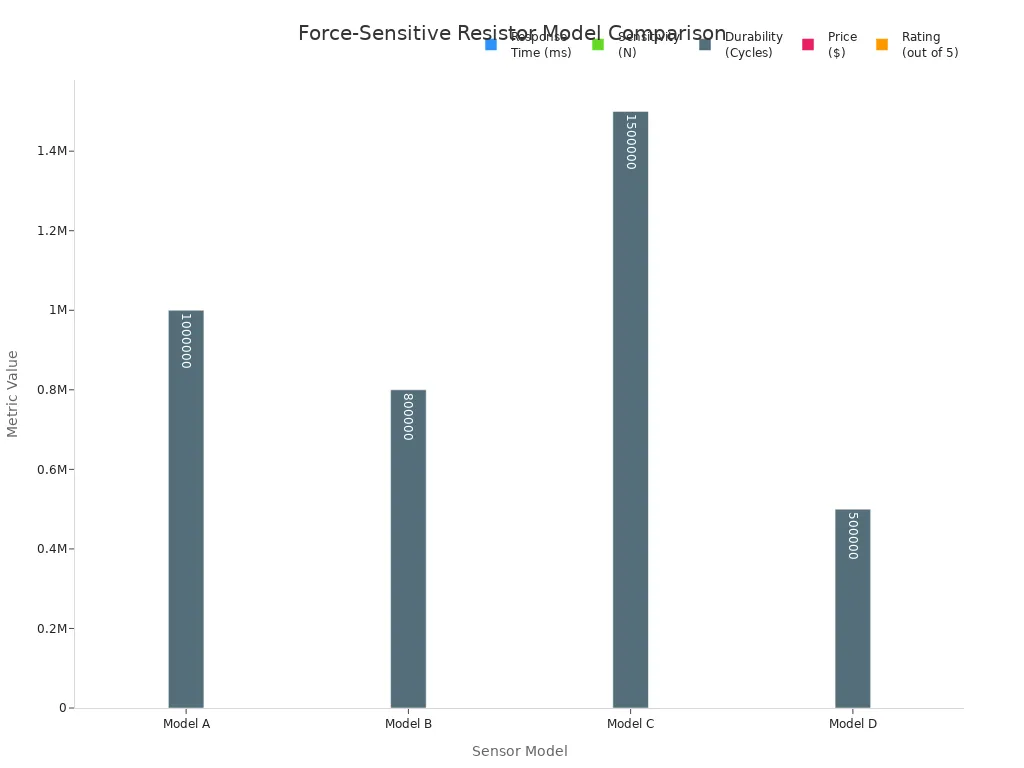
Model C is the best choice overall. It has high sensitivity and lasts a long time. Its rating is the highest in the group. The price is more, but you get great performance and steady results. If you need a force sensing resistor for many jobs, Model C gives you the best mix of features.
Best Value Model
If you want a good deal, look for force sensing resistors that work well and do not cost too much. SOUSHINE FSRs are a smart choice for this. Many people pick SOUSHINE because:
- They react quickly to changes in force, so you get data fast.
- The sensors stay accurate for a long time, so you can trust them.
- They are easy to use and set up, which saves you effort.
- You can use them in sports, healthcare, and robots, so they are flexible.
- SOUSHINE helps customers solve problems quickly.
You do not need to buy the most expensive sensor to get good results. SOUSHINE gives you a fair price, strong sensitivity, and long life. This makes them a smart choice for lots of projects.
Best for Robotics
Robots need force sensing resistors that react fast and last through many uses. You want sensors that are sensitive and respond quickly. These things help robots hold objects and move safely. SOUSHINE and Interlink both have sensors that work well for robots. SOUSHINE lets you change the shape and size for your robot. You also get strong durability and steady accuracy. Interlink sensors are good for robot arms and grippers, giving you feedback you can trust.
When you build a robot, you need sensors that last and give the right reading every time. Pick force sensing resistors with high sensitivity, long life, and a price you can afford. This helps your robot work better and last longer.
Best for Healthcare
You need force sensing resistors that give accurate results in healthcare. Hospitals and clinics use these sensors to watch patients and keep them safe. You can find these sensors in beds, wheelchairs, and rehab tools. They help doctors and nurses know if a patient moves or needs help.
Pick sensors with high sensitivity for healthcare jobs. This lets you notice even small pressure changes. Even a tiny change can be important for a patient. Sensors with strong sensitivity give better data. You can use this data to stop bed sores or help patients heal faster.
Price is important when buying sensors for medical devices. You want sensors that last a long time and work well. SOUSHINE force sensing resistors have high sensitivity and last long. You can get them in special shapes or sizes for your needs. This makes them fit many kinds of medical equipment. FlexiForce sensors are also very sensitive and accurate. Hospitals use them in heart catheters and therapy tools.
Here is a table to compare force sensing resistors for healthcare:
| Brand | Sensitivity | Durability | Customization | Price (USD) | Main Use |
|---|---|---|---|---|---|
| SOUSHINE | High | 1,000,000+ | Yes | $2 – $10 | Beds, rehab |
| FlexiForce | Very High | 1,500,000+ | Yes | $5 – $18 | Catheters, PT |
| Interlink | Medium-High | 800,000+ | Limited | $3 – $12 | Wheelchairs |
| Ezweiji | Medium | 500,000+ | No | $1 – $5 | Basic monitors |
Choose sensors with high sensitivity and long life. This helps you get good results and save money. You can ask for custom sensors if you need a special size or shape. SOUSHINE and FlexiForce work best for healthcare. Their sensors fit many medical devices.
Tip: Test your sensors before using them with patients. This helps you check if they are sensitive and accurate in real life.
Think about price, sensitivity, and how long the sensor lasts. If you want the best deal, SOUSHINE gives strong performance and a fair price. FlexiForce is good for jobs that need very high sensitivity. Interlink and Ezweiji are fine for simple jobs and cost less.
The right force sensing resistors help patients stay safe and heal faster. You get better data, save money, and give better care. Always match the sensor to your device and test it before using it.
You have learned which force-sensitive resistors are good for different jobs in 2025. SOUSHINE is a great pick because it gives you good value and can be changed to fit your needs. FlexiForce and Tekscan are best if you want very accurate sensors for medical or airplane projects. Look at the quick reference table to see how the choices compare. Try out some sensors before you buy them. If you are not sure, ask the companies for help. Always pick a sensor that fits your project so you get the best results.
FAQ
What is a force-sensitive resistor (FSR)?
You use a force-sensitive resistor to measure force or pressure. When you press the sensor, its resistance drops. You can use FSRs in many devices to detect touch or weight.
How do I choose the right FSR for my project?
You check the sensitivity, size, and durability. You match the sensor’s force range to your needs. You look at your budget and ask about custom shapes if your design needs them.
Can I use FSRs in outdoor environments?
You can use some FSRs outside. You pick models with strong environmental resistance. You check if the sensor works in heat, cold, or wet places before you install it.
How long do FSRs usually last?
You get long life from most FSRs. Many models last over 1,000,000 cycles. You check the durability rating in the datasheet to make sure the sensor fits your project.
Do FSRs need calibration?
You should calibrate FSRs for best accuracy. You test the sensor with known weights or forces. You adjust your system to match the readings for your application.
What applications use FSRs most?
You find FSRs in cars, medical devices, robots, consumer electronics, factories, and airplanes. You use them for touch detection, pressure monitoring, and safety systems.
Can I customize the shape or size of an FSR?
You can ask brands like SOUSHINE for custom shapes and sizes. You get sensors that fit your design and meet your project’s needs.
Are FSRs easy to connect to microcontrollers?
You connect FSRs easily to microcontrollers. You use simple circuits with resistors and analog inputs. You read the sensor’s output with platforms like Arduino or Raspberry Pi.