

Call us: +86-137-2353-4866


You want to find the fsr sensor with the best price and performance in 2025. It is important to compare force sensitive resistor price and value. Every project needs something different. SOUSHINE is a leader with advanced force sensing technology. They offer reliable force sensing resistor solutions for cars, healthcare, and robots. The market is growing quickly. Electric vehicles in Germany and Asia Pacific need more sensors. Manufacturers now use more sensors than before. Picking the right sensor saves money and helps you do better.
Table of Contents
Key Takeaways
- Pick the best FSR sensor for your project. Think about sensitivity, how long it lasts, and how much it costs.
- SOUSHINE FSR sensors are sensitive and strong. They do not cost too much. They work well for many uses.
- FlexiForce sensors are very accurate. They are great for medical and science jobs. They cost more than others.
- Ezweiji sensors are cheap and good for easy projects. They work well for school and DIY kits. They are sensitive enough for light jobs.
- Interlink FSR 402 is a good choice for saving money. It has medium-high sensitivity and lasts a long time. The price is fair.
- Always check the FSR sensor details. Look at how fast it works and if it can handle tough places. Make sure it fits your project.
- Buy in bulk to save money. Many brands give discounts for big orders. This lowers the price for each sensor.
- Many brands let you change sensors to fit your needs. This helps make them work better for your project.
Best FSR Sensor Models for Price and Value in 2025
Top Overall FSR Sensor Picks
You want to pick the best fsr sensor for your project. You care about how much it costs, how sensitive it is, and how long it lasts. In 2025, experts say these models are the best for price and value:
- SOUSHINE FSR
- Interlink 408
- Ezweiji FSR
The table below lets you compare these force sensitive resistor models. It shows sensitivity, durability, customization, price, and what they are used for. This helps you see what makes each sensor special.
| Brand | Sensitivity | Durability | Customization | Price (USD) | Main Use |
|---|---|---|---|---|---|
| SOUSHINE | High | 1,000,000+ | Yes | $2 – $10 | Beds, rehab |
| FlexiForce | Very High | 1,500,000+ | Yes | $5 – $18 | Catheters, PT |
| Interlink | Medium-High | 800,000+ | Limited | $3 – $12 | Wheelchairs |
| Ezweiji | Medium | 500,000+ | No | $1 – $5 | Basic monitors |
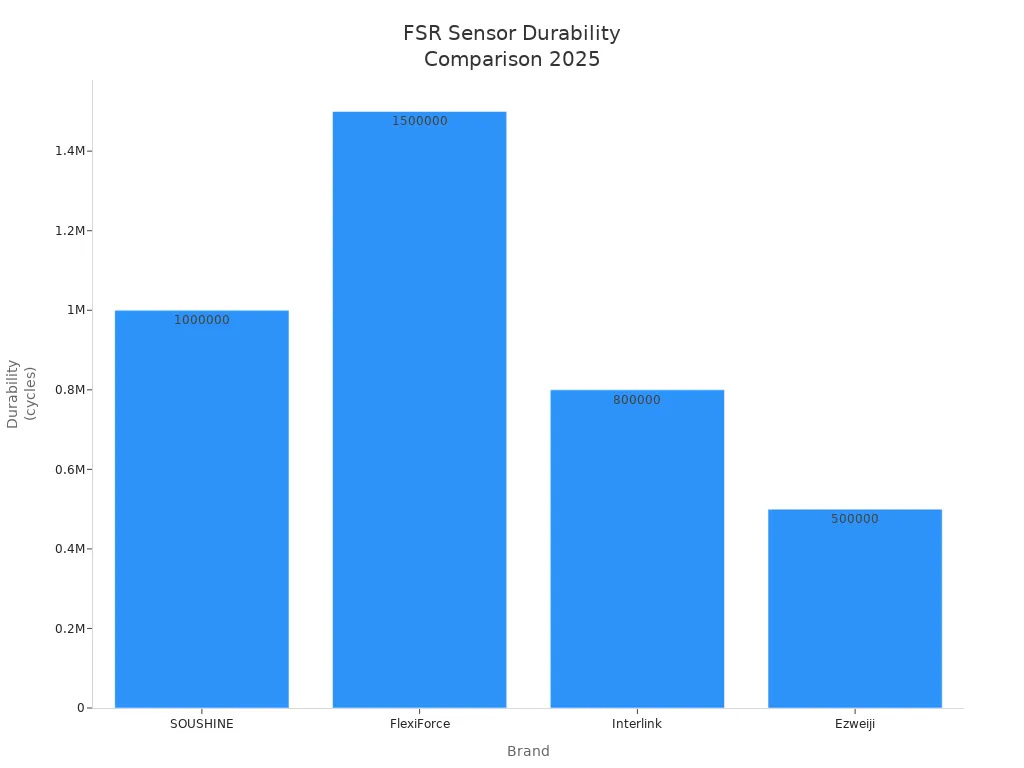
SOUSHINE and FlexiForce have high sensitivity and last a long time. Interlink and Ezweiji are good if you want something simple and cheap. SOUSHINE is great if you need help or want to change the sensor for your project. You can find a sensor that fits your needs and budget.
Best Value Force Sensitive Resistor
You want a force sensitive resistor that is a good deal. You look at how fast it works, how sensitive it is, how long it lasts, and the price. The table below helps you see the top models side by side.
| Sensor Model | Response Time (ms) | Sensitivity (N) | Durability (Cycles) | Price ($) | Rating (out of 5) |
|---|---|---|---|---|---|
| Model A | 5 | 0.5 | 1,000,000 | 15 | 4.5 |
| Model B | 7 | 0.7 | 800,000 | 12 | 4.0 |
| Model C | 6 | 0.6 | 1,500,000 | 18 | 4.7 |
| Model D | 4 | 0.4 | 500,000 | 10 | 3.8 |
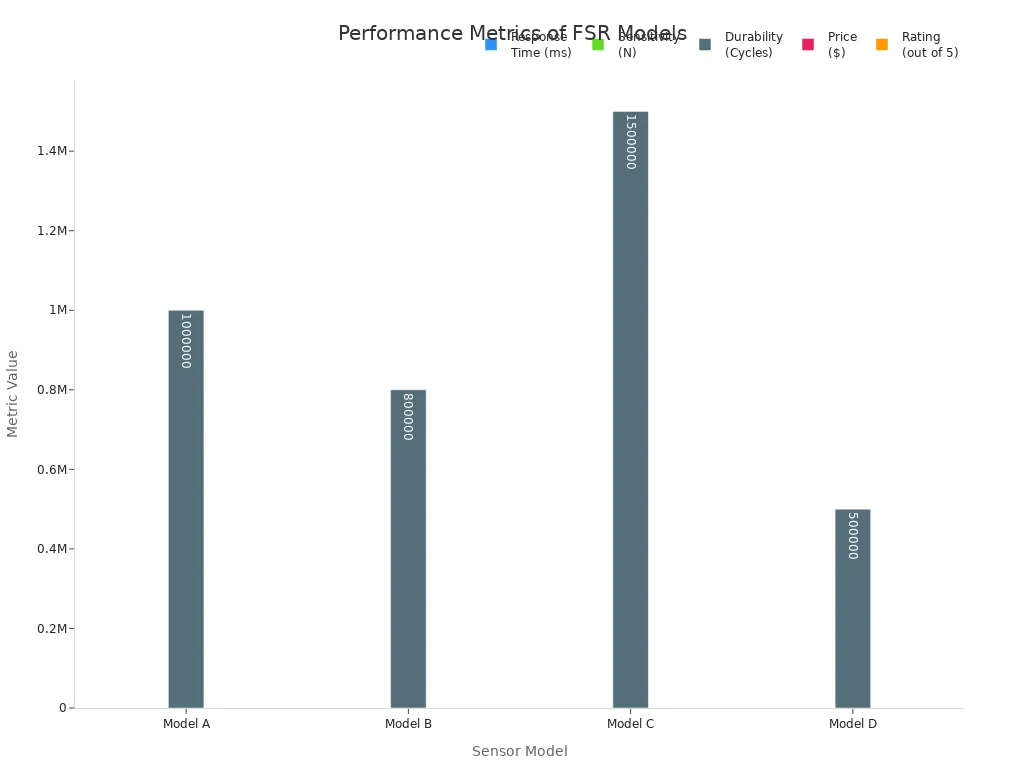
Model C lasts the longest and has the best rating, but it costs more. Model A is a good mix of sensitivity, durability, and price. Model D is the cheapest, but it is not as sensitive or tough. Pick the one that matches your budget and how much sensitivity you need.
Best for Specific Applications
You need force-sensitive resistors for different things. Each job needs a sensor with the right sensitivity, durability, and price. Here are some top choices for common uses:
- Automotive: SOUSHINE FSR sensors are good for car seats and brakes. They are sensitive and last a long time for a fair price.
- Healthcare: FlexiForce sensors are used in medical tools like catheters and rehab devices. They are very sensitive and last long, but cost more.
- Robotics: Interlink FSR sensors help robots feel touch. They have medium-high sensitivity and a fair price.
- Consumer Electronics: Ezweiji FSR sensors are used in simple monitors and gadgets. They are cheap and sensitive enough for easy jobs.
Tip: Always check the force sensitive resistor price and value before you buy. You want to balance cost, sensitivity, and durability for your project.
You can find a sensor that works for you. SOUSHINE gives you many ways to change the sensor and get help. FlexiForce is best for medical jobs. Interlink and Ezweiji are good for simple and cheap projects. You get the best results when you pick the right sensor for your job.
FSR Sensor Technology and Market Trends
What is a Force Sensitive Resistor?
A force sensitive resistor is a small device. It helps you measure how much force you use. When you press it, the sensor changes its resistance. You can find these sensors in car seats, medical tools, and robots. They give you feedback about pressure and touch right away. These sensors help make products smarter and safer.
SOUSHINE is a top company for these sensors. Their sensors last a long time. You can change the size, shape, thickness, or color. This lets you design the sensor you need for your project.
| Feature | SOUSHINE’s Technology | Competitors |
|---|---|---|
| Accuracy | High | Lower |
| Durability | Long-lasting | Varies |
| Customization | Many choices | Fewer choices |
| Power Consumption | Low | Higher |
| Integration Ease | Simple | Harder |
How FSR Sensors Work
FSR sensors work in a simple way. When you press the sensor, tiny particles inside move closer. This makes the resistance go down. If you do not press, the resistance is high. If you press harder, the resistance gets lower. The sensor turns this change into an electrical signal. You can measure this signal as voltage in your circuit.
- FSRs change resistance when you press them.
- No force means high resistance, sometimes very high.
- Pressing lowers resistance to a smaller number.
- Your circuit reads the voltage to show the force.
This lets you track pressure and touch very well. SOUSHINE sensors can handle over 10 million presses. You get good value and reliability.
2025 Market Overview and Innovation
The market for force sensitive resistors is growing fast. More cars, healthcare, and smart devices need these sensors. Companies put them in wearables and other technology. The market could reach $4.02 billion by 2032. In 2025, it is $2.57 billion.
Here are some important trends for 2025:
- More industries want smart and automatic features.
- You see sensors in more wearables and gadgets.
- Companies make sensors smaller and more sensitive.
- Prices are competitive, so you get better deals.
- Research brings new uses and better performance.
You should watch these trends for the best value and sensitivity. SOUSHINE leads with high accuracy and low power use. Their sensors are easy to use and fit your needs. You get a sensor that keeps up with new technology.
Comparing Force Sensitive Resistor Price and Features by Brand
SOUSHINE FSR Sensor Lineup
SOUSHINE FSR-402
You want a force sensitive resistor you can trust. The SOUSHINE FSR-402 is very sensitive and lasts a long time. It works well in beds, rehab tools, and smart gadgets. The price is between $2 and $10. The cost depends on how many you buy and if you want changes. This model is special because it senses many force levels and is tough. It reacts fast and keeps working after millions of uses. If you want a sensor that is not too expensive but works well, this is a good choice.
SOUSHINE FSR-406
The SOUSHINE FSR-406 is even more flexible. It fits in small spaces and different shapes. You still get high sensitivity and long life like the FSR-402. The price is fair, so you do not spend too much. Many engineers use the FSR-406 for wearables, robots, and electronics. You can trust this sensor to give you good results every time.
Customization and Support
SOUSHINE knows every project is unique. You can talk to their engineers to pick the size, shape, and sensitivity you want. Making changes is a big part of what they do. Here are some ways you can make your sensor special:
- Put your logo on the sensor.
- Pick packaging that matches your brand.
- Ask for special pictures or designs.
- Change the sensing area and how sensitive it is.
- Choose the electrical ending that fits your circuit.
| Customization Feature | Description |
|---|---|
| Customized logo | SOUSHINE lets you add your own logo. |
| Customized packaging | You can get special packaging. |
| Graphic customization | You can ask for your own graphics. |
You also get help from the start to the end. SOUSHINE helps you figure out what you need, test your sensor, and fix problems. This support gives you more value and helps your sensor work its best.
Interlink FSR Models
FSR 400
The Interlink FSR 400 is a favorite for many projects. It senses force from about 0.2N up to 20N. This model is very thin, so it fits in tight spots. The price is about $3.99, which is good if you want both value and sensitivity. The FSR 400 can be pressed millions of times, so you do not need to replace it often.
FSR 402
The Interlink FSR 402 is like the FSR 400 but has a different shape and size. It still has good sensitivity and a fair price. This model is used in wheelchairs, smart mats, and simple robots. You can change it for special jobs, but there are fewer options than SOUSHINE.
| Feature | Description |
|---|---|
| Dynamic sensing range | About 0.2N to 20N |
| Actuation durability | Lasts for millions of presses |
| Form factor | Very thin |
| Customization | Some changes possible |
| Cost | Price is $3.99 |
Flexiforce Premium Sensors
Flexiforce A201
Flexiforce sensors are very accurate and repeat the same results. The A201 model is thin and bends easily. It can handle heavy loads and works in hot or cold places, from -40°C to 85°C. The price is higher, but you get great sensitivity and long life—over 3 million presses. If you need a sensor for medical or science use, the A201 is a strong pick.
Flexiforce ESS301
The Flexiforce ESS301 is even better. It senses both light and heavy forces. This model is best for hard jobs where you need accuracy and strength. The price is higher than other brands, but you get the best if you need exact data.
| Feature | Flexiforce | Other Brands |
|---|---|---|
| Accuracy | Very accurate and repeats | High accuracy |
| Longevity | Over 3 million presses | Changes by brand |
| Thickness | 0.008 inches | Changes by brand |
| Temperature Range | -40°C to 85°C | Changes by brand |
| Sensitivity Range | Wide (g–kg) | Changes by brand |
Tip: If you want the best sensitivity and accuracy, Flexiforce sensors are worth the extra money. For most jobs, you can find a sensor that fits your budget and still works well.
Ezweiji and Other Notable Brands
Ezweiji Extra-Long FSR
Ezweiji is a good choice if you want something simple and cheap. Their sensor works well for easy jobs. The extra-long FSR from Ezweiji has a bigger area. This helps when you need to sense force over more space. You often find these sensors in schools, DIY kits, and small factories. The price is low, so you can buy many without spending much.
Here’s a quick table to show how Ezweiji compares to others:
| Brand | Main Strengths | Typical Applications | Price Range |
|---|---|---|---|
| Ezweiji | Low cost, simplicity | Education, DIY, light industry | Low |
| Tekscan | High accuracy, variety | Medical, robotics, research | Mid to high |
Ezweiji focuses on saving you money. Their force sensitive resistor price is one of the lowest. If you need a sensor for a school project or a simple device, you get good sensitivity for less money. You do not get as many features as expensive brands. But you save money and still get results you can trust.
SparkFun and Adafruit Models
You might want to use force-sensitive resistors from SparkFun or Adafruit. These brands make it easy to start with force sensing resistors. They are great if you like building things yourself. Their sensors work for light and medium force. You can use them in school projects, simple robots, or art projects.
Look at this table to see how their models are different:
| Brand | Model Name | Force Range | Application Suitability |
|---|---|---|---|
| SparkFun | Thin and bendy FSRs | Light to medium | School projects, DIY electronics, simple robots |
| Adafruit | Round Force-Sensitive Resistor (FSR) – Alpha MF01A-N-221-A01 | 0.3 ~ 10 Newton | Maker projects, touch toys, pressure mats |
| Adafruit | Round High Force Sensitive Resistor (FSR) – Alpha MF01A-N-221-A05 | 1 ~ 100 Newton | Art projects, touch controls, pressure mats |
SparkFun and Adafruit have sensors for different force levels. This gives you choices. If you want to sense a soft touch, pick a sensor with high sensitivity. If you need to sense a hard press, choose a model for more force. The price is fair, so you get good value.
When you look at the force sensitive resistor price from SparkFun and Adafruit, you see they keep costs low for students and hobbyists. You get enough sensitivity for most fun projects. These sensors help you learn about force sensing without spending a lot.
Tip: If you want to try or teach force sensing, use Ezweiji, SparkFun, or Adafruit. You get a good mix of price, sensitivity, and value. If you need more accuracy or strength, you can always upgrade to flexiforce sensors or other advanced models.
You have many brands to pick from for force sensitive resistors. Ezweiji, SparkFun, and Adafruit help you start small and save money. You get good sensitivity and a fair price, so they are great for learning and testing ideas.
FSR Sensor Performance: Sensitivity, Accuracy, and Durability
Sensitivity and Response
You want your sensor to react fast and notice small changes. Sensitivity shows how well a sensor can feel light or hard presses. Most force sensing resistors answer in less than one millisecond. This means you get feedback right away when you press.
Here’s a table that shows how sensitive and quick top models are:
| Model | Force Measuring Range | Response Time |
|---|---|---|
| FSR FA402 | 100g ~ 10KG | <1 ms |
| Alpha MF01A-N-221-A01 | 30g ~ 1000g (0.3N ~ 10N) | <1 ms |
You can use these sensors in projects where speed is important. If you need to measure a soft tap or a strong push, these sensors work well. You always get quick results.
Accuracy and Repeatability
Accuracy means your sensor gives the right number each time. Repeatability means it gives the same number if you press the same way again. Force sensing resistors have some limits with this. You might see small changes because of time, heat, or wet air. Sometimes, sensors from the same group act a bit different.
Here are some things to remember:
- Sensors can change after lots of use.
- Weather can make readings different.
- Strain gauges are better for very exact jobs.
- Force sensing resistors are good for most uses, but not for super exact work.
If you need perfect numbers, you may want a different sensor. For most projects, force sensitive resistor sensors are accurate enough.
Durability and Environmental Resistance
You want your sensor to last a long time, even with daily use. Durability means the sensor can take many presses and not break. Environmental resistance means it works in hot, cold, or wet places.
Look at this table for how tough these sensors are:
| Sensor Model | Test Load | Actuations | Linearity Error | Sensitivity Change |
|---|---|---|---|---|
| A301 | 2.3 kg | 1,000,000 | < ±3% | N/A |
| ESS301 | 2.3 kg | 1,000,000 | < ±3% | N/A |
| HT201 | 2.3 kg | 1,000,000 | < ±3% | N/A |
You can count on force sensing resistors to last through many uses. They keep working in all kinds of weather. If you need a sensor for a hard job, these models are strong and steady.
Tip: Always check the specs for sensitivity, accuracy, and durability before you pick a sensor. You want the best deal for your project.
Force Sensitive Resistor Price Comparison Table 2025
Price Ranges by Brand and Model
You want to know how much you will pay for a force sensitive resistor. The price can change a lot depending on the brand and model. Some sensors cost just a few dollars, while others are more expensive because they offer extra features or better performance. Here’s a quick look at what you can expect:
| Brand | Model | Price Range (USD) |
|---|---|---|
| SOUSHINE | FSR-402 | $2 – $10 |
| SOUSHINE | FSR-406 | $2 – $10 |
| Interlink | FSR 402 | $2.99 |
| Interlink | FSR 404/406 | $3.99 |
| FlexiForce | A201 | $5 – $18 |
| Ezweiji | Extra-Long | $1 – $5 |
| Sensitronics | ThruMode | $8.00 |
You see that SOUSHINE gives you a wide range of options. Interlink and Ezweiji offer lower prices for basic needs. FlexiForce and Sensitronics cost more, but they give you high-end features.
Cost vs. Value Analysis
When you look at the price, you also want to think about what you get for your money. Some sensors may cost less, but they might not last as long or work as well in tough jobs. Others may have a higher price, but they give you better sensitivity, more durability, or extra support.
- SOUSHINE sensors give you a good balance of price and value. You get strong performance and the chance to customize your sensor.
- Interlink offers reliable sensors at a fair price, which works well for many projects.
- FlexiForce sensors cost more, but you get top accuracy and long life.
- Ezweiji is great if you want the lowest price for simple tasks.
Tip: Always match the sensor’s price to your project’s needs. Sometimes, paying a little more saves you money in the long run because you get better results and fewer replacements.
Bulk and OEM Pricing
If you need a lot of sensors, you can save money by buying in bulk. Many brands offer special prices for large orders. Here’s how the price drops as you buy more:
| Quantity (pieces) | Price per piece |
|---|---|
| 1 – 5 | $6.20 |
| 6 – 200 | $1.80 |
| 201 – 1000 | $1.60 |
| > 1000 | To be negotiated |
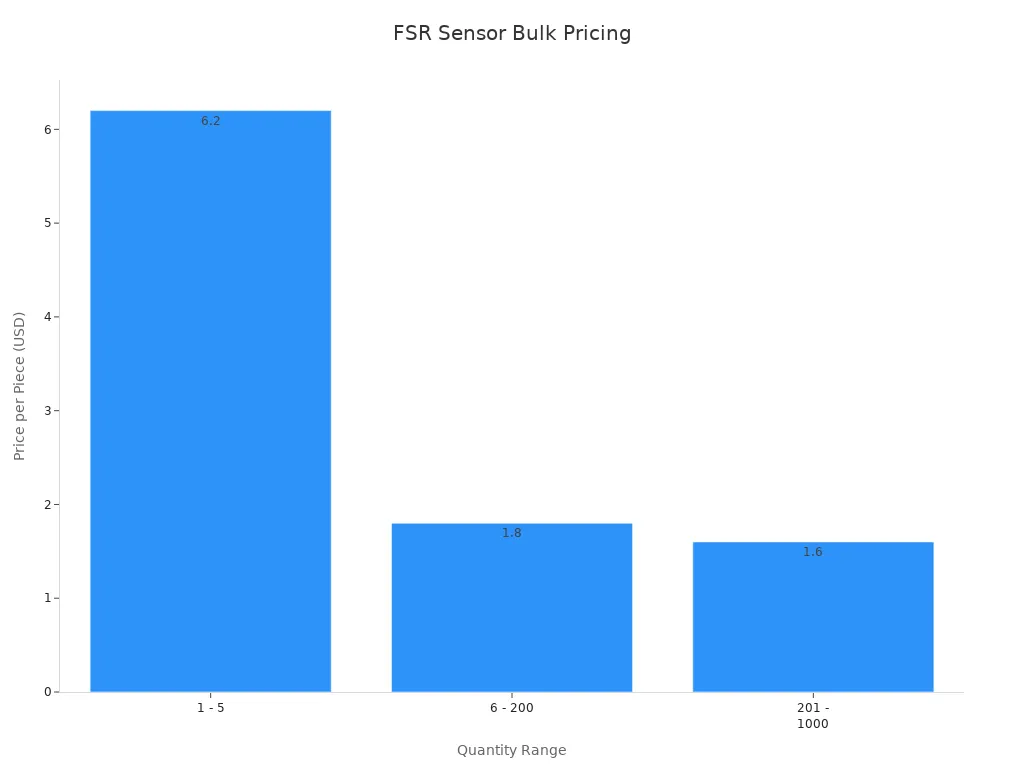
You can also ask for special features when you order in bulk. Many brands let you add your logo, pick custom packaging, or change the graphics if you order at least 100 pieces. Sensitronics and SOUSHINE both offer volume pricing and custom options for big orders.
- Customized Logo (Min. order: 100 pieces)
- Customized Packaging (Min. order: 100 pieces)
- Graphic Customization (Min. order: 100 pieces)
If you plan to use FSR sensors in your own products, talk to the brand about OEM pricing. You can often get the best price and the exact sensor you need.
Choosing the Right FSR Sensor for Your Application
Application-Based Recommendations
You want to pick the best FSR sensor for your project. Different jobs need different types of sensors. Let’s look at what works best for each application:
| Application Need | Best FSR Type | Example Use Case |
|---|---|---|
| Wide force measurement | Shunt Mode | Car seat sensors |
| Light touch detection | Thru Mode | Robotic grippers |
| Fast response | Thru Mode | Touch panels |
| Heavy-duty environments | Shunt Mode | Industrial machines |
Automotive and Safety
You use FSR sensors in cars for seat belt sensors, seat occupancy, and braking systems. These sensors need high sensitivity and a wide force range. You want a sensor that gives you good value and keeps your car safe. Shunt mode sensors work well here because they handle big changes in force.
Healthcare and Wearables
In healthcare, you need sensors for patient monitoring, prosthetics, and wound care. You want high sensitivity to catch even the smallest touch. Thru mode sensors fit best. They help you track patient safety and comfort. Wearables also need thin, flexible sensors that fit in small spaces.
Robotics and Automation
Robots need to feel touch. You use FSR sensors to help robots pick up objects gently. High sensitivity is key. Thru mode sensors give you fast response and let robots handle things with care. You get better control and less damage to objects.
Consumer Electronics and Industrial
You find FSR sensors in touch panels, smart gadgets, and machines. These jobs need sensors with fast response and good durability. Shunt mode sensors work well in heavy-duty machines. For gadgets, you want sensors with high sensitivity and a fair price.
Tip: Always match the sensor’s sensitivity and type to your project’s needs. This helps you get the best value and performance.
Budget and Value Considerations
You want to get the most for your money. The price of FSR sensors changes based on how many you buy. Buying more sensors lowers the unit price. Here’s a quick look:
| Quantity | Unit Price (US$) |
|---|---|
| 1 | 13.49 |
| 5 | 12.68 |
| 25 | 11.92 |
| 100 | 11.20 |
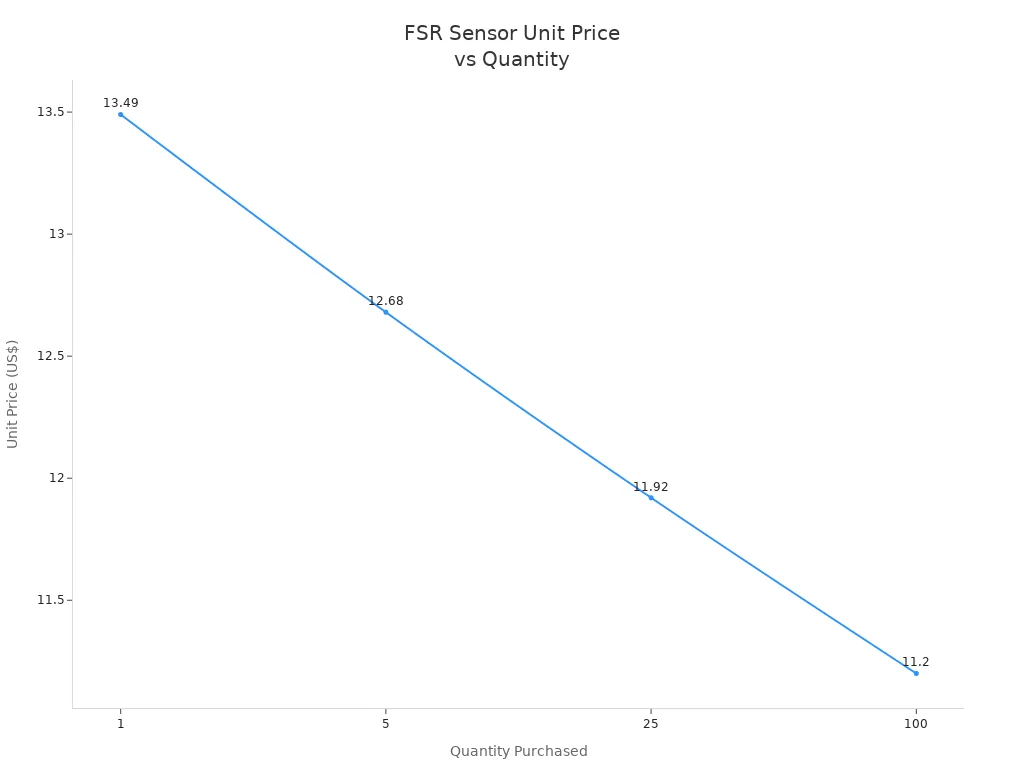
Choosing the right sensor based on price and value helps you stay on budget. Sometimes, a higher-quality sensor costs more at first but saves you money later. You replace it less often and spend less on repairs. Always think about both the upfront cost and the long-term value.
Tips for Evaluating FSR Sensors
Before you buy, check these important points. This helps you pick the right sensor for your job:
| Tip | Description |
|---|---|
| Cost | Know what you really need. Don’t pay for features you won’t use. |
| Durability | Make sure the sensor can handle the stress and conditions of your project. |
| Environment | Think about where you will use the sensor. FSRs resist dust and moisture. |
| Form Factor | Pick a sensor that fits your space. FSRs are thin and flexible. |
| Repeatability | Check if the sensor gives the same reading every time. Some brands have more part-to-part variation. |
| Sensitivity | Choose the right sensing range. Newer models offer more sensitivity for different uses. |
Note: Always test a few sensors before you buy in bulk. This way, you know you get the right sensitivity, price, and value for your project.
Recommendations: Best FSR Sensor for Price, Value, and Application
Best Overall FSR Sensor
You want a sensor that does it all. The SOUSHINE FSR-402 stands out as the best overall choice for 2025. You get high sensitivity, strong durability, and a fair price. This sensor works in many places, like beds, rehab tools, and smart gadgets. You can count on it for millions of presses. The FSR-402 gives you a wide range of force detection, so you can use it for both light and heavy touches. You also get help from SOUSHINE’s team if you need to change the sensor for your project. The price stays reasonable, even if you want custom features. If you want a sensor that balances sensitivity, cost, and long life, this one fits your needs.
Tip: If you want a sensor that works in many jobs and lasts a long time, try the SOUSHINE FSR-402. You get great value for your money.
Best Value for Money
You want the most for your money. The Interlink FSR 402 gives you strong performance at a good price. This sensor offers medium-high sensitivity and lasts through many uses. You can use it in wheelchairs, smart mats, and simple robots. The price is lower than some high-end models, but you still get good results. If you need a sensor that balances cost and sensitivity, this one is a smart pick. You do not pay extra for features you do not need. The Interlink FSR 402 gives you solid value, especially if you buy in bulk.
Here’s a quick table to help you compare:
| Model | Sensitivity | Durability | Price (USD) | Best Use |
|---|---|---|---|---|
| SOUSHINE FSR-402 | High | 1,000,000+ | $2 – $10 | Many applications |
| Interlink FSR 402 | Med-High | 800,000+ | $2.99 | Robotics, mats |
Best for Precision Applications
You need top accuracy for medical or science work. The FlexiForce A201 leads in precision. This sensor gives you very high sensitivity and repeatable results. You can use it in catheters, rehab devices, and lab tools. The A201 works in tough places, like hot or cold rooms. You pay a higher price, but you get the best sensitivity and data. If you need to measure small changes in force, this sensor helps you do the job right. The cost is worth it when you need exact numbers.
Note: For jobs that need perfect accuracy, always check the sensor’s specs for sensitivity and repeatability. The FlexiForce A201 gives you peace of mind when every detail matters.
You have many choices for FSR sensors. Think about what matters most for your project—price, value, cost, or sensitivity. Pick the sensor that matches your needs and budget.
Best for Durability
You need a force sensitive resistor for hard jobs. Durability is important when your sensor gets pressed a lot or used roughly. If you want a sensor that lasts long, check out the FlexiForce ESS301. This sensor is built strong and lasts a long time. You can press it over a million times and it still works. The ESS301 works in hot, cold, or wet places. It keeps its sensitivity, so your readings stay correct.
Here’s a table to compare tough FSR sensors:
| Model | Durability (Cycles) | Sensitivity Range | Price (USD) | Best Use |
|---|---|---|---|---|
| FlexiForce ESS301 | 1,000,000+ | Wide | $15 – $20 | Medical, industry |
| SOUSHINE FSR-406 | 1,000,000+ | High | $2 – $10 | Wearables, automation |
| Interlink FSR 402 | 800,000+ | Medium-High | $2.99 | Robotics, smart mats |
FlexiForce ESS301 and SOUSHINE FSR-406 both last a long time. SOUSHINE FSR-406 is very sensitive and costs less. If you want a sensor that is tough and sensitive, SOUSHINE is a good choice. You save money because you do not need to buy new sensors often.
Tip: Always look at how durable the sensor is before buying. A sensor that is sensitive and lasts long saves you money and problems.
Best Budget Option
You want to spend less but still need a sensor that works well. The Ezweiji Extra-Long FSR is the best cheap choice. This sensor is sensitive enough for easy jobs. You can use it for school, DIY kits, or simple monitors. The price is low, so you can buy many without spending a lot.
Here are some reasons Ezweiji is a smart budget pick:
- Each sensor costs little
- Good sensitivity for light work
- Simple to use in different projects
You might think cheap sensors are not good. Ezweiji sensors still work well for basic needs. If you want to try ideas or teach about force sensing, this sensor helps you start without spending much.
| Model | Sensitivity | Price (USD) | Best Use |
|---|---|---|---|
| Ezweiji Extra-Long | Medium | $1 – $5 | Education, DIY |
| SparkFun Thin FSR | Medium | $2 – $6 | Maker projects |
| Adafruit Round FSR | Medium | $3 – $7 | Art, touch panels |
Note: If you need more sensitivity or toughness, you can buy a better sensor later. For now, Ezweiji gives you great value if you want to save money.
You have lots of choices. Think about what matters most—sensitivity, price, or how long it lasts. Pick the sensor that matches your project and your budget.
There are lots of good FSR sensor options in 2025. SOUSHINE is a top pick for price and value. It is also great if you want to change the sensor or need help. You should think about what is most important for your project. Maybe you care about accuracy, size, speed, or how much you can spend. FlexiForce is best for jobs that need very exact results. Ezweiji is good for easy projects that do not need much. If you want sensors that are smart and not too expensive, SOUSHINE is a good choice. Do you have questions or want to tell us what you think? Leave a comment below!
FAQ
What is an FSR sensor?
An FSR sensor is a force sensing resistor. You press it, and it changes resistance. You can use it to measure touch or pressure in many devices.
How do I choose the right FSR sensor for my project?
Think about what you need. Check the force range, size, and price. Look at how sensitive and durable the sensor is. Pick one that matches your application.
Can I customize an FSR sensor?
Yes! Many brands, like SOUSHINE, let you change the size, shape, or even add your logo. You can ask for special features to fit your project.
How long do FSR sensors last?
Most FSR sensors last for hundreds of thousands or even millions of presses. If you use them gently, they last longer. Always check the specs for durability.
Are FSR sensors waterproof?
Some FSR sensors resist water and dust. If you need a waterproof sensor, look for one with an IP rating or ask the manufacturer for details.
What is the price range for FSR sensors?
Prices start as low as $1 for basic models. Advanced or custom sensors can cost $10 or more. Buying in bulk usually lowers the price per sensor.
Where can I use FSR sensors?
You can use FSR sensors in cars, medical devices, robots, wearables, and even art projects. They work well anywhere you need to measure touch or pressure.