

Call us: +86-137-2353-4866
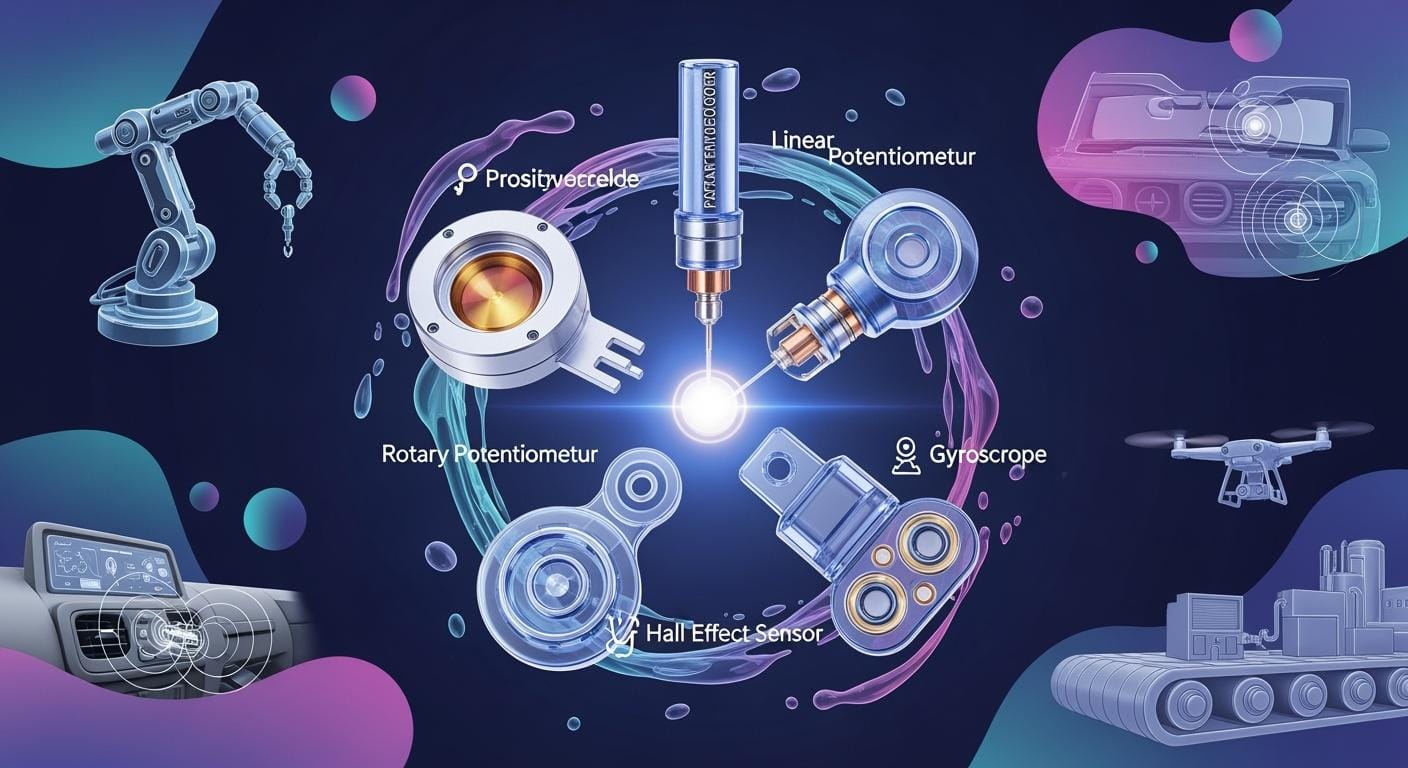

You use position sensors every day, even if you do not notice. These devices help cars open airbags. They guide robotic arms. They keep machines working well. Here are 10 important types you can find in real life:
| Sensor Type | Example Use |
|---|---|
| Potentiometric | Linear motion tracking in machinery |
| LVDT | Industrial automation for displacement |
| Rotary Encoder | Steering position in vehicles |
| Linear Encoder | Robotics and CNC machines |
| Hall Effect | Throttle and pedal detection |
| Magnetoresistive | IoT smart locks |
| Capacitive | Touch panels and proximity sensing |
| Inductive | Metal detection in assembly lines |
| Optical | Object detection in robotics |
| Force Sensing Resistor | SOUSHINE’s Seat Occupancy Sensors in cars |
You can see force sensing resistor technology in SOUSHINE’s Seat Occupancy Sensors. These sensors help make cars safer. As more people want these sensors, you should learn how force sensing works. You also need to know which sensor is best for you.
Table of Contents
Key Takeaways
- Position sensors are very important in technology today. They help machines know where things are. They also help keep people safe.
- There are many types of position sensors. Potentiometric and rotary encoders do special jobs in different industries.
- Force-sensing resistors help keep cars safe. They can tell if someone is sitting in a seat. This helps airbags work at the right time.
- When picking a position sensor, think about the environment. Also, think about how exact it needs to be. You should also think about how to install it.
- Position sensors will get smaller and smarter soon. They will work with more devices. This will help make more things automatic.
- Optical and ultrasonic sensors can measure without touching things. This makes them good for fragile items.
- If you know how each sensor works, you can pick the best one. This helps you get what you need.
- Keep learning about new sensor technology. This helps you make good choices for safer and better systems.
Understanding Position Sensors
What Are Position Sensors
Position sensors act like the eyes for machines. They help machines know where things are. These devices measure the spot or movement of an object. You can find them in cars, robots, and factory machines.
Here is a simple table to show what they do:
| Core Function/Definition | Description |
|---|---|
| Measurement of Position | Tells you exactly where something is located. |
| Contact-free Measurement | Checks position without touching, so nothing gets worn out. |
| Critical Feedback | Gives important info to keep machines safe and working right. |
You see these sensors working every day. They help robots move arms and guide cars. They keep factories running well. In engineering, these sensors are very important. They help control movement and make sure products are good quality.
How Position Sensors Work
Position sensors use different ways to find movement or location. Some use light, and some use magnets or electricity. For example, optical sensors use light to find where something is. When light hits an object, it bounces off. The sensor collects this light to know the spot. Spatial filtering uses special fibers to pick up only certain light, making it more exact.
Inductive sensors work in another way. They use electromagnetic induction. When metal moves close, it changes the magnetic field. The sensor notices this and tells you the new spot.
Here is a quick table about these ideas:
| Principle | Description |
|---|---|
| Scattering | Uses bounced light to find the edge or spot of a material. |
| Spatial Filtering | Uses special fibers to pick up the right light for better results. |
| Electromagnetic Induction | Finds changes in magnetic fields when metal moves nearby. |
To pick the best sensor, think about what you need to measure. Also, think about where you will use it.
Why Position Sensors Matter in 2025
Position sensors will be even more important soon. You will see them in more cars, especially self-driving ones. These sensors help cars see things, stay in lanes, and keep people safe. Electric cars use them for motor and battery control.
In factories, these sensors help machines work faster and better. Newer gadgets use them to get smarter and easier to use.
Note: New rules and safety needs make companies use sensors that are more exact and last longer. This means you will see better sensors in places where safety is very important.
Position sensors will get smaller and smarter. They will connect to more things. Because of this, you will see them used in more ways, making life safer and easier.
Types of Position Sensors
Potentiometric Sensors
Principle
Potentiometric sensors have a resistive track and a wiper. The wiper moves along the track. When it moves, the resistance changes. This change helps measure where something is. You see these sensors in things with knobs or levers. Potentiometric sensors are contact sensors. They give an analog signal that matches the position.
Here is a table that shows how potentiometric sensors compare to other types:
| Feature/Metric | Potentiometric Sensors | Other Position Sensors (Inductive, Magnetostrictive) |
|---|---|---|
| Cost | Low | Higher |
| Accuracy | Typically Low | Higher |
| Repeatability | Typically Low | Higher |
| Linearity | N/A | Higher |
| Robustness | N/A | Higher |
Tip: Potentiometric sensors are good if you want something simple and cheap. Use them when you do not need high accuracy.
Applications
Potentiometric sensors are in many things you use every day. They help you change volume, tune sensors, and set speeds. Here is a table with common uses:
| Application Type | Specific Uses |
|---|---|
| Volume Control in Audio Systems | Amplifiers, radios, headphones, home audio systems |
| Sensor Calibration and Tuning | Temperature sensors, light sensors, gas sensors |
| User Interface Controls | Fan speed controls, oven temperature dials, motor speed controllers |
| Position and Angle Sensing | Robotic arms, joystick modules, automotive throttle position sensors |
You often use potentiometric sensors in controls. They let you change settings easily. In robots, they help measure angles or positions.
LVDT Sensors
Principle
LVDT means Linear Variable Differential Transformer. This sensor has a coil and a core that moves. When the core moves, the voltage in the coil changes. The sensor tells you the exact position. LVDT sensors are non-contact sensors. Nothing inside touches, so they do not wear out.
LVDT sensors have many good points:
- They work without friction, so they are good in places with shaking.
- They can measure very small changes.
- They last a long time because there is no contact.
- They work well in tough places.
Here is a table that compares LVDT sensors to linear potentiometers:
| Specification | LVDT | Linear Potentiometer |
|---|---|---|
| Contact Type | Non-contacting | Contacting (unless specified) |
| Measurement Principle | Voltage change from core movement | Resistance change from wiper movement |
| Operational Life | Very high due to non-contact | Limited due to mechanical wear |
| Environmental Sealing | IP68 | Varies, generally less robust |
| Application Suitability | Aerospace, instrumentation | Factory automation, motorsport |
Applications
You see LVDT sensors in many fields. They help measure and control movement where you need things to work well.
| Industry | Application |
|---|---|
| Aerospace | Measuring flight control surface positions, monitoring aircraft structures, feedback for control systems. |
| Automotive | Throttle position sensing, suspension systems, vehicle dynamic control. |
| Industrial Automation | Monitoring and controlling production processes, used in automated assembly lines and robotic arms. |
| Healthcare | Measuring displacement and position in medical devices like MRI machines and patient monitoring systems. |
LVDT sensors give accurate feedback in hard places. You can trust them in planes, cars, and medical equipment.
Rotary Encoders
Principle
Rotary encoders measure how much something turns. They track how far and how fast it spins. Rotary encoders are non-contact sensors. They use optical or magnetic technology to sense movement. This makes them last longer and work with high precision.
Rotary encoders give feedback right away. You can watch robot joints turn and make fast changes. This helps you control machines very well.
Here is a table that shows the main advantages of rotary encoders:
| Advantage | Description |
|---|---|
| Precision | Rotary encoders provide high precision in measuring angular movements, essential for accurate control. |
| Real-time feedback | They offer instantaneous updates on position and speed, crucial for applications like CNC machines. |
| Versatility | Different types of encoders can be used based on installation needs, enhancing adaptability. |
| Non-contact operation | They use optical or magnetic technology, improving lifespan and reducing wear from mechanical contact. |
| High resolution | Enables accurate measurement of small angular movements, beneficial in various precise applications. |
Applications
Rotary encoders are in many modern machines. They are important in automation and robotics. You also see them in factories, cars, and medical tools.
| Market Segment | CAGR (2022-2029) | Applications in Industries |
|---|---|---|
| Rotary Encoders | 8.2% | Automotive, aerospace, electronics, healthcare, manufacturing, and packaging. |
You use rotary encoders to control robot arms and track motor speed. They also guide CNC machines. Their high precision and fast feedback make them important for advanced machines.
Note: As more things get automated, people want more rotary encoders. You will see them in more factories and smart devices.
Linear Encoders
Principle
Linear encoders measure straight movement. These sensors track where something is as it moves. They use optical, magnetic, inductive, or capacitive technology. The sensor reads changes in a scale. It sends a signal to show the object’s spot. This signal is very accurate.
Here is a table that compares linear and rotary encoders:
| Feature | Linear Encoders | Rotary Encoders |
|---|---|---|
| Motion Type | Measure straight-line motion | Measure rotational motion |
| Application | Used in applications like cutting fabric to length | Used in applications like motor shaft position sensing |
| Accuracy | Expressed in µm per unit of length (µm/m) | Expressed in arcseconds or degrees |
| Technology | Can be optical, magnetic, inductive, capacitive, etc. | Can also be optical, magnetic, inductive, etc. |
| Most Accurate | Optical encoders are the most accurate | Optical encoders are also the most accurate |
Tip: Pick linear encoders for exact straight-line measurement.
Applications
Linear encoders are important in engineering and automation. You find them in machines that need exact feedback. These sensors help protect machines and lab samples. You can use cheaper motors and still get good results.
Here are features that make linear encoders useful:
| Feature | Description |
|---|---|
| High Accuracy | Keeps errors small, good for precise work. |
| Reliability | Works well for a long time, great for automation. |
| Cost Efficiency | Good balance of price and performance, used in many fields. |
| Adaptability | Works with many materials and setups, fits many jobs. |
You see linear encoders in these places:
- Automation and electronics production equipment.
- Linear drives and measuring tools.
- Lab machines that protect samples and equipment.
You can put linear encoders on easily with adhesive film. This saves time and effort.
Hall Effect Sensors
Principle
Hall Effect sensors find magnetic fields. When a magnetic field goes through, it makes voltage. You use this voltage to find where something is or how it moves. Hall Effect sensors do not touch the object. This makes them last longer and not wear out.
Here is a table with Hall Effect sensor advantages:
| Advantage | Description |
|---|---|
| Compact Design | Easy to put in many places in vehicles. |
| Low Wear and Tear | No touching means less damage, so they last longer. |
| High Temperature Resistance | Works well at high heat, good for engines. |
| Resistance to Environmental Factors | Works in places with shaking, water, and dust. |
| Low Electromagnetic Interference | Built-in processing keeps signals clear. |
| Detection Capability | Finds things that do not move and slow targets, so it is reliable. |
Note: Hall Effect sensors work well in tough places like engines and factories.
Applications
You find Hall Effect sensors in many electronics. They help control ignition, speed, and safety. You use them to find position and movement without moving parts.
Here are some common uses:
- Ignition systems
- Speed controls
- Security systems
- Alignment controls
- Current limit switches
- Position detectors
- Rotary encoders
You also see Hall Effect sensors used for:
| Application Type | Description |
|---|---|
| Magnetometers | Measures magnetic field strength for engineering. |
| Magnetic Field Detection | Finds magnetic fields and sends signals or switches circuits. |
| Current and Voltage Sensing | Measures current and shows it as signals. |
| Position and Motion Sensing | Used in machines to find magnetic fields without moving parts. |
| Ignition Timing | Needed for correct engine timing in cars. |
In cars, Hall Effect sensors help with power and safety. You use them to measure engine position and speed. This helps cars work better and safer.
Magnetoresistive Sensors
Principle
Magnetoresistive sensors measure resistance changes from magnetic fields. You use these sensors to find position, speed, and direction. They work well where you need high sensitivity and reliability.
Magnetoresistive sensors give good feedback even in hard places.
Applications
You find magnetoresistive sensors in cars and factories. They help sense magnetic fields, measure current, and find position. You use them for speed and tilt angle checks. These sensors also help with navigation and tracking.
Here are some common uses:
- Engine speed and crankshaft checks
- Transmission feedback
- Brake systems
- Emissions control
- Speed sensing
- Position finding
- Direction detection
- Proximity sensing
You trust magnetoresistive sensors for jobs needing exact position and speed checks. They help keep cars and machines safe and working well.
Capacitive Sensors
Principle
Capacitive sensors check changes in electrical capacitance. Inside, there are two metal plates. When something gets close, the electric field changes. The sensor notices this and shows the position or movement. You do not need to touch the object for it to work. This makes capacitive sensors good for measuring position without contact.
Tip: Capacitive sensors can find tiny changes in distance or touch. You can set them up for many different jobs.
Applications
Capacitive sensors are used in lots of industries. They help measure position, how close something is, and thickness. Here are some main benefits:
- You get very high accuracy for measuring distance.
- These sensors work best in clean places.
- You can use them for checking proximity, movement, and acceleration.
- They help measure thickness, shape change, and vibration.
- Tactile capacitive sensors block most electromagnetic interference.
- They can handle strong electric or magnetic fields and static discharge.
In factories, capacitive sensors are important. You use them to find objects and check levels. They last a long time and work well in tough places. They also help make work faster and more exact.
Common Uses:
- Touch screens and panels
- Checking liquid levels in tanks
- Making sure materials are the right thickness
- Watching for vibration in machines
You can trust capacitive sensors when you need accurate position sensing without touching.
Inductive Sensors
Principle
Inductive sensors use electromagnetic fields to find metal objects. Inside, there is a coil. When metal gets close, the magnetic field changes. The sensor sees this and sends a signal. Inductive sensors do not need to touch the object. This makes them strong and last a long time.
Here is a table that shows why inductive sensors work well in tough places:
| Characteristic | Description |
|---|---|
| Highly reliable | Non-contact, solid-state design keeps out dirt and stops failures. |
| Accurate | Good electronics give you exact readings. |
| Robust | Strong parts handle shaking and high heat. |
| Simulation tested | Engineers test sensors in real places to prevent problems. |
| Heat protected | Special circuits help sensors work in hot spots. |
Note: Inductive sensors work even if it gets hot or wet. They do not have moving parts, so they break less often.
Applications
Inductive sensors are used in many automatic systems. They help find metal parts and control machines. Here are some common uses:
| Application | Description |
|---|---|
| Metal Detectors | Find metal things in many places. |
| Traffic Lights | Sense cars at crossings for better traffic flow. |
| Car Washes | Find where cars are in automatic washes. |
| Automated Processes | Help machines know when parts are ready or when to stop. |
You also use inductive sensors to:
- Find parts at workstations
- Watch conveyor stops
- Check air cylinder positions
- Make sure pallets are in the right spot
Inductive sensors are often used as end-of-stroke sensors in machines and hydraulic cylinders. You can trust them for important safety jobs in military, aerospace, and heavy industry.
Optical Sensors
Principle
Optical sensors use light to find where things are or how they move. Inside, there is a light source and a detector. When something blocks or bounces the light, the sensor notices. Optical sensors give quick and exact feedback. They do not touch the object, so they last longer.
Optical fiber sensors, like Fiber Bragg Grating (FBG) sensors, use changes in light patterns to measure shape and strain. You get instant feedback for hard tasks.
Applications
Optical sensors are used in many high-tech areas. They help robots, machines, and doctors do their work better. Here are some ways you use them:
- Factory robots use optical sensors for exact jobs, even fast ones.
- Warehouse robots use optical tracking to move and pick things.
- In hospitals, optical sensors guide careful surgical tools.
- In farming, smart machines use them to follow rows and plant seeds.
Key Advantages:
- High report rates (60 Hz or more) give fast updates.
- Quick and exact feedback helps robots work better.
- Optical sensors block electromagnetic interference and stay strong in tough places.
You can count on optical sensors for making things, robotics, and other advanced jobs that need high precision.
Ultrasonic Sensors
Principle
Ultrasonic sensors use sound waves to find distance and position. The sensor sends out high-frequency sound waves. These waves hit an object and bounce back. The sensor measures how long the echo takes to return. This time helps you figure out how far the object is. You do not need to touch the object, so the sensor does not get worn out.
Tip: Ultrasonic sensors work well in dark places. You can trust them when light sensors do not work.
You can use ultrasonic sensors with microcontrollers. They are simple to set up and safe to use. The sensor does not care about the object’s color or if it is see-through. You get correct readings every time.
Applications
Ultrasonic sensors are used in many industries. They help measure position, find objects, and control machines. Here are some main benefits:
- Non-contact design helps the sensor last longer.
- High accuracy lets you measure small changes.
- Shape detection helps you know the size and form of things.
- Material detection works on any surface or color.
- They are affordable, so many people use them.
Here is a table showing where ultrasonic sensors are used:
| Industry | Application Examples |
|---|---|
| Healthcare | Non-contact measurement systems |
| Automotive | Safety features, Advanced Driver Assistance Systems (ADAS) |
| Industrial Automation | Process monitoring |
| Smart City Applications | Traffic management, Waste management |
You see ultrasonic sensors in cars for parking help and crash prevention. In factories, they watch production lines and control robots. Hospitals use them to check patients without touching them. Cities use these sensors to help with traffic and waste.
Note: The United States uses many ultrasonic sensors because of new technology. Europe is also growing fast, especially in cars and healthcare.
Force-Sensing Resistor Sensors
Principle
Force-sensing resistor sensors, or FSRs, change resistance when you press on them. You put a thin, bendable sensor under a surface. When you push on it, the resistance goes down. The sensor sends this change to a control unit. You get a digital signal that shows how much force you used.
FSRs work well in car seats. You can put them between the foam and cover without changing the seat. The sensor finds the weight and spot of the person sitting. The link between resistance and pressure is important. More pressure means less resistance. This helps you get good readings for safety systems.
Tip: Temperature can change how the sensor works. Good sensors work in many conditions to keep your data right.
Applications
You use force-sensing resistor sensors in many products. They help measure force, pressure, and touch. Here are some important uses:
- Athletic Apparel: Shoe insoles find foot pressure. You make better running shoes and help stop injuries.
- Medical Applications: Sensors control medicine and check pressure on hospital beds. You keep patients safe from bed sores.
- Robotics: Robotic arms use FSRs for feedback. You can hold fragile things safely.
- Inventory Control: Shelves use FSRs to track stock levels. You know when items change.
- User Interface Controls: FSRs work as buttons you do not need to press hard. You can set actions based on how much force you use.
You also find FSRs in car systems. Car door handles and dashboard controls use these sensors for touch features.
SOUSHINE’s Seat Occupancy Sensors use advanced FSR technology. You get good data about who sits in the car seat. The sensor finds weight, posture, and seat spot. This helps the car know when to use airbags and remind you to wear your seat belt. You make every passenger safer.
Note: FSRs are important in position sensors for car safety. You need them for smart airbags and seat belt reminders.
Other Types of Sensors in Position Detection
Proximity Sensors
Principle
Proximity sensors help you find out if something is close. They do not need to touch the object. These sensors use different ways to sense things. Some use electromagnetic fields. Others use light or sound waves. When something gets near, the sensor sends a signal. No contact means the sensor lasts longer.
Tip: Proximity sensors are good for places where you want less damage.
Applications
Proximity sensors are in many things you use. Here are some examples:
- Smartphones: Your phone turns off the screen near your ear.
- Automatic doors: Doors open when you walk close to them.
- Robots: Robots use these sensors to avoid hitting things.
- Factory machines: Machines stop or start when objects move in place.
| Application Area | Example Use |
|---|---|
| Consumer Devices | Screen control in phones |
| Retail | Automatic entry doors |
| Robotics | Obstacle detection |
| Manufacturing | Part detection on assembly lines |
You can count on proximity sensors for safety and easy use.
Tilt Sensors
Principle
Tilt sensors help you know if something tilts or moves. Inside, there is a small ball or liquid. When you tilt the device, the ball moves or liquid shifts. The sensor sees this and sends a signal. You get a fast answer when the angle changes.
Note: Tilt sensors give quick and simple feedback about position.
Applications
Tilt sensors are in many things you use every day. Here are some examples:
- Smartphones and tablets: The screen turns when you rotate your device.
- Game controllers: The sensor tracks your moves for better games.
- Construction equipment: Machines use tilt sensors to stay safe and level.
- Shipping: Companies use these sensors to check if packages tip over.
| Device Type | How Tilt Sensors Help |
|---|---|
| Mobile Devices | Screen orientation |
| Gaming | Motion control |
| Heavy Machinery | Safety and stability |
| Logistics | Package monitoring |
Tilt sensors help make things safer and easier to use.
Absolute Position Sensors
Principle
Absolute position sensors tell you the exact spot of something. These sensors use codes or patterns for each position. When you move something, the sensor reads the code. It knows the exact place every time. You get a special value for every spot, so you never lose track.
Alert: Absolute position sensors work even if the power goes out. You always know the real position.
Applications
Absolute position sensors are used when you need to know the exact spot. Here are some examples:
- Robotics: Robots use these sensors to move arms to the right place.
- Industrial machines: Machines need to know where parts are for safety.
- Medical devices: Doctors use tools that must track movement very closely.
- Elevators: The system always knows which floor the elevator is on.
| Industry | Example Use |
|---|---|
| Robotics | Arm positioning |
| Manufacturing | Machine part tracking |
| Healthcare | Surgical tool guidance |
| Building Systems | Elevator floor detection |
You can trust absolute position sensors for jobs that need to be exact and reliable.
Choosing the Right Position Sensor
Key Criteria
When you pick a sensor, you want it to work well for your job. You should look at several important factors. The table below shows what you need to check:
| Criteria | Description |
|---|---|
| Reliable Sensing Distance | How far the sensor can detect the target accurately. |
| Environmental Suitability | How well the sensor works in heat, cold, dust, or water. |
| Mounting Requirements | How you can install the sensor in your system. |
| Signal Form | The type of signal the sensor sends out, such as analog or digital. |
| Size & Mounting | The sensor’s size and how it fits into your design. |
| Energy & Voltage Requirements | The power the sensor needs to run. |
| Resolution & Range | How small a change the sensor can notice and the biggest change it can measure. |
| Response Speed | How fast the sensor reacts to movement or changes. |
| Environmental Durability | How well the sensor stands up to shocks, chemicals, or electric noise. |
| Certifications & Standards | If the sensor meets safety or industry rules. |
| Connectivity Options | How the sensor connects to other devices or systems. |
| Warranty | The promise the maker gives about how long the sensor will work. |
| Cost | The price you pay for the sensor and what you get for it. |
Tip: Always match the sensor’s features to your project’s needs. This helps you avoid problems later.
Application Fit
You need to choose a sensor that fits your job. Start by thinking about what you want to measure. For example, if you need to track a robot arm’s angle, a rotary encoder works well. If you want to know if someone sits in a car seat, a force-sensing resistor sensor like SOUSHINE’s Seat Occupancy Sensor is a smart choice.
Here are some steps to help you match sensors to your application:
- Write down what you want to measure (distance, angle, touch, or presence).
- Think about the environment (wet, dusty, hot, or cold).
- Decide if you need fast response or high accuracy.
- Check if you need the sensor to last a long time or handle rough use.
- Look at how the sensor will connect to your system.
Note: You can use a table or checklist to compare different sensors for your project. This makes your choice easier.
Trends for 2025
Sensor technology keeps getting better. In 2025, you will see new features that make sensors smarter and easier to use. The table below shows some big trends:
| Trend | Description |
|---|---|
| Intelligence | Sensors can now check themselves, process data, and adjust to new situations. They help you make faster and better decisions. |
| Miniaturization | Sensors get smaller and lighter. You can fit them into more devices, like phones and wearables. |
| Multifunctionality | One sensor can measure more than one thing at a time. This saves space and money, especially in factories. |
| Integration | You can put many sensors together on one chip. This makes your system smaller and uses less power. |
| Networking | Sensors connect to the internet and talk to each other. You can control and watch them from anywhere, which is great for smart homes and smart cities. |
Callout: When you choose position sensors, think about these trends. Picking a sensor with new features can help your project last longer and work better.
You now know why position sensors matter in so many fields. When you pick a sensor, think about your needs and the latest trends.
- Choose a trusted brand like SOUSHINE for safety and strong performance.
- Stay informed about new sensor technology to make smart choices in 2025 and beyond.
Remember: The right sensor helps you build safer and smarter systems.
FAQ
What is a position sensor?
A position sensor shows where something is or how it moves. You use it to check distance, angle, or if something is there. These sensors help machines work safely and do their jobs right.
How do I choose the right position sensor?
Think about what you want to measure. Look at where you will use the sensor. Decide how exact you need it to be. Make sure the sensor fits your system and keeps things safe.
Where do you find position sensors in daily life?
You see position sensors in cars, phones, robots, and factory machines. They help with safety and control. For example, cars use them for airbags and seat belts.
What makes SOUSHINE’s Seat Occupancy Sensors special?
SOUSHINE’s Seat Occupancy Sensors use smart force-sensing technology. They know if someone sits in the seat. This helps control airbags and seat belt reminders. Every passenger gets better safety.
Can position sensors work in tough environments?
Yes, many position sensors work in heat, cold, dust, or water. Always check the sensor’s details to make sure it works for you.
Do position sensors need regular maintenance?
Most position sensors need little or no care. Non-contact sensors last longer because nothing wears out. You should still check them sometimes to keep things safe.
Are position sensors expensive?
Position sensors come in many prices. Simple ones cost less. Advanced ones with more features cost more. Pick one that fits your budget and needs.
Why are position sensors important for safety?
Position sensors help machines know where things are. They make sure airbags work at the right time. Robots move safely because of them. Using the right sensor keeps people and equipment safe.